The sampling rate of the raw data of the B-Train is 1 kHz, which is very high for a neural network for prediction, one second of data is 1000 points. This means that if one would want to do predictions for 10s, it would be 10 000 points, which is significant for large neural networks. Especially for LSTMs that are fully recurrent and computation time scales directly with number of samples.
Downsampling the time series by an integer factor, for instance 50, which results in a signal at 20 Hz, significantly reduce the number of points that are used for training and prediction. However the regular interval downsampling introduces artifacts in regions of the signal where the rate of change is high.
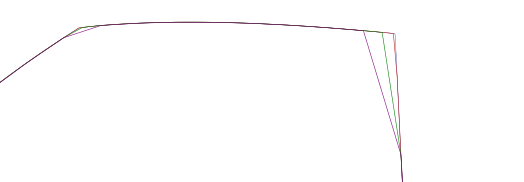
Which depending on the phase of the signal, can give inconsistent downsampled signals for an identical waveform with a different phase. This makes it difficult for the model learn the true relationship.
Adaptive Downsampling
Adaptive downsampling reduces Time Series Compression artifacts by preserving more points in high rate-of-change regions, unlike regular interval downsampling which introduces phase-dependent artifacts.
Compression Algorithms
Primary Methods
- Swinging Door Algorithm - Threshold-based door method
- Ramer-Douglas-Peucker Algorithm - Recursive line simplification
Alternative Approaches
- Wavelet decomposition
- Derivative-based downsampling - naive approach using first and second order gradients, difficult with noisy signals
Non-uniform time-axis
A consequence of using adaptive downsampling is that the samples become irregularly spaced in time. While for most time-series tasks, interpolation is used to fill in the missing time steps. However in our case we purposely want to reduce the amount of data, and therefore must add the temporal information in the date.
One can either add relative time indices () or absolute time (), normalized, to the input features in addition to the other inputs like current and past field.
Resources
https://stats.stackexchange.com/questions/312609/rnn-for-irregular-time-intervals https://stats.stackexchange.com/questions/384656/lstm-random-and-always-different-time-between-data-measurements