Overview
Advantages
- Physically-Based: The model is grounded in physical concepts of magnetization processes within ferromagnetic materials, such as domain wall motion and anhysteretic magnetization.
- Accurate Major Loop Prediction: It can accurately reproduce major hysteresis loops for many ferromagnetic materials.
- Insight into Material Behavior: Provides valuable insights into the underlying physics of magnetization, allowing for a deeper understanding of material behavior.
Disadvantages
- Numerical Stability Issues: Can exhibit numerical stability problems, particularly under certain conditions like stiff equations and parameter sensitivity.
- Minor Loop Accuracy: May not always accurately predict minor loops, which are crucial for understanding dynamic behavior.
- Parameter Identification: Accurate parameter identification can be challenging and may require sophisticated optimization techniques.
- Computational Cost: Can be computationally more expensive than some other models, especially for complex simulations.
The JA model, as with any ODE, when solving, tends to accumulate numerical errors over time, especially over extended simulations over time. This is a behaviour that may make the Preisach model more preferable.
Implementation
Implemented by Verena in hysteresis-simulator 2024-05-31.
- Integrate Jiles-Atherton model into hysteresis-simulator. [priority:: high] [due:: 2024-06-03] [completion:: 2024-06-05]
Further improvements have been implemented by using Octave code on GitHub and running it through oct2py.
Parameter tuning
Iron core magnet
For an iron core magnet, the Jiles-Atherton parameters are:
ja_params = JilesAthertonParameters(
    a = 1195.86,  # A/m
    alpha = 0.0013740,
    c = 0.1772,
    k = 2150.43,  # A/m
    Ms = 1728184,  # A/m
)
However the hysteretic response leaves a very high remanent field, which is not so representative for the accelerator magnets, where the field mainly follow the anhysteretic magnetization curve.
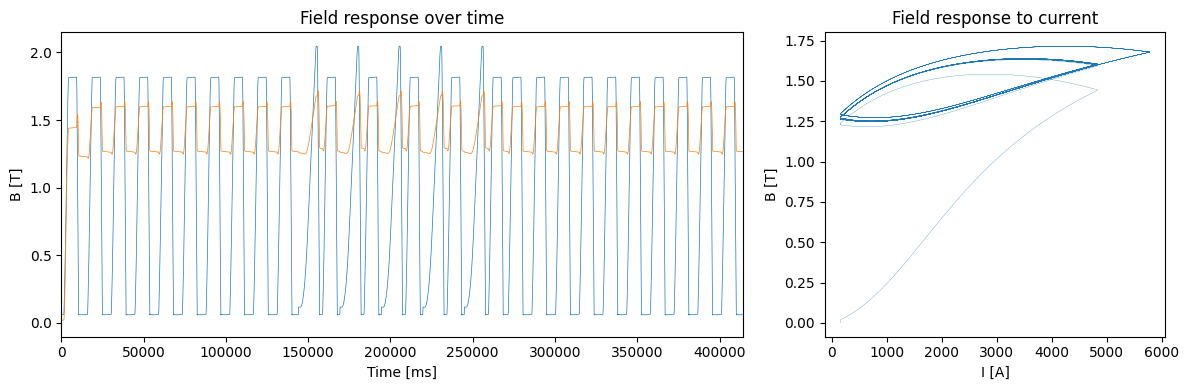 or for a stepwise ramping field