Lab measurements are planned for the MBIs.
Measuring absolute integral field
The measurements will be marked using a set of hall sensors that approximate the integral field. There are MBI HOLEC measurement limitations.
https://gitlab.cern.ch/epa-wp4/mm_discrete2integral
- Follow up with Maurus progress on hall sensor placement optimization [priority:: high] [due:: 2024-08-22] [completion:: 2024-08-22]
- Install additional hall sensors in lab dipole measurement bench [priority:: high] [due:: 2024-08-23] [completion:: 2024-08-27] Given to Christian (867) 2024-08-27
- Design waveforms that conform to the power converter limitations [priority:: high] [due:: 2024-08-26] [completion:: 2024-08-27]
- Perform lab measurements of main dipoles and mark with hall sensor [priority:: highest] [due:: 2024-08-27] [completion:: 2024-10-02]
- Train on lab measurements with the best model from Comparison of models on validation data. [completion:: 2024-10-02]
Waveforms to measure
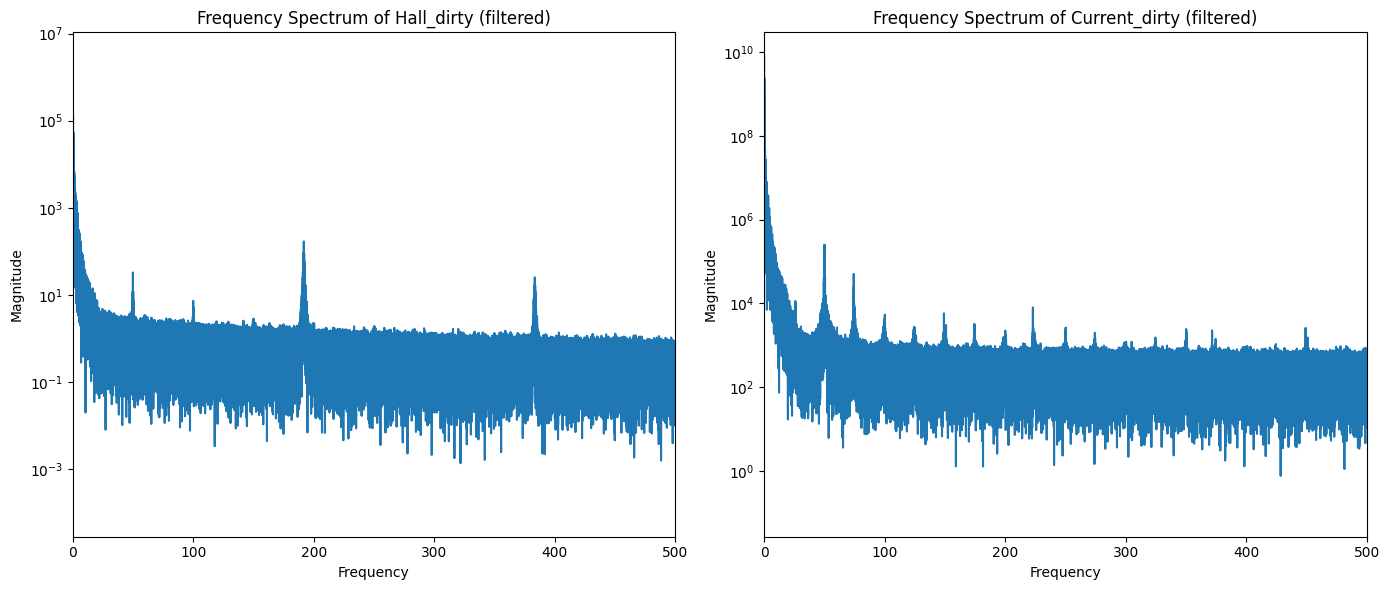
The frequency spectrum clearly shows the 50 Hz harmonics in the measured current. Here the data i is filtered with a median filter with kernel size 201. In the measured current one can see additional frequency harmonics in the power supply, many of which are filtered out when looking at the field response.
The time series show that a median filter kernel size of more than 51 risk oversmoothing the 50 hz ripples. We also note that the measurement accuracy of the current is limited to , equivalent to about field response. Notice also how the denoised signal yields only about accuracy peak to peak
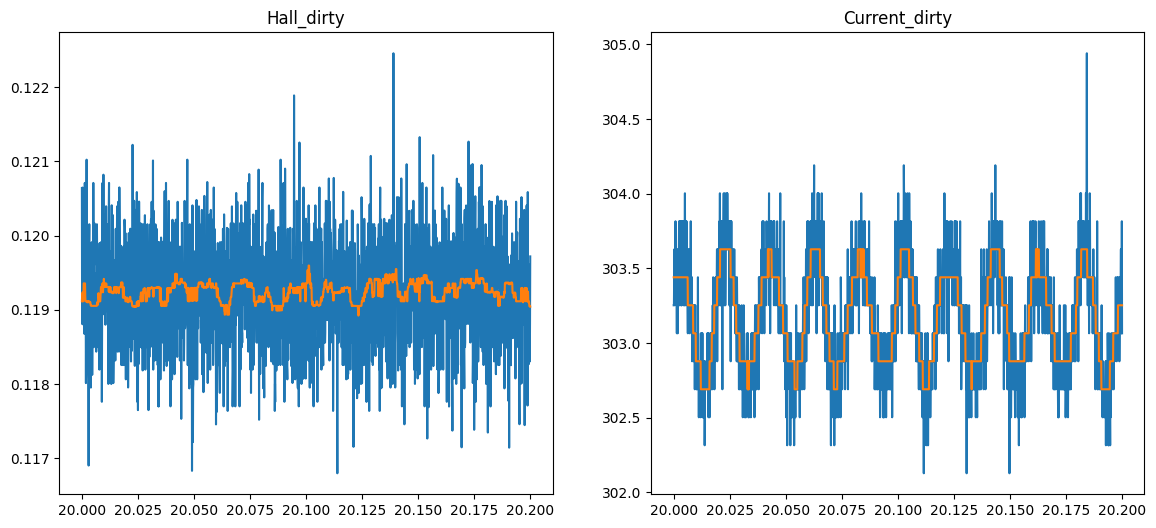
- Investigate 0.2 A measurement limit in measurements. This is important for quadrupoles where small changes in current are common in the machine. [priority:: low] [completion:: 2024-10-21]
- Investigate 50 Hz ripple, if we want to model it, and in that case what our effective sampling rate should be. [completion:: 2024-10-21]
Investigating the 50 Hz ripple is also important for measurement of the higher order magnets, which will exhibit a similar effect. Subtracting a calibration function is also adding additional unwanted noise to the measured field, which may not be desirable, and this is the same as if we subtract a linear component.
To model the 50 Hz we need to sample with at least 100 Hz (downsample=10) to avoid smoothing out important components. To smooth out the 50 Hz we could also measure the same waveform multiple times and average out the measurements like in Average multiple measurements for noise reduction.
The 0.2 A measurement step for the current can be solved by introducing another DCCT in the lab. However whether this is useful since the 50 Hz ripples have an amplitude of 0.7 A, this remains to be seen.
- Increase current measurement accuracy in the lab. [priority:: medium] [completion:: 2024-11-21]