MD preparation
Ensure we have enough headroom with chromaticity, flatten the SFTPRO injection momentum ramp.
- Switch to 3x SFT with “flat MD1 clone” (but with dipoles still pulsing), take reference
- Switch dipole precycle off, shift dipole field by 5e-5T, based on first turn
- Correct eddy current decay with 1-shot trim
- Adjust transmission as necessary
MD execution
- Switch to LHCPILOT supercycle, observe change on spill, transmission and injection.
- If injection OK, check flattop predictions
- Repeat the same for LHC1 supercycle
- Compensation on flat top if injection stays constant
Supercycles
- SFTPRO1 - MD3 - SFTPRO1 - MD3 - SFTPRO1 - MD3
- SFTPRO1 - ZERO - LHCPILOT - MD3
- SFTPRO1 - ZERO - LHC1 - MD3
- SFTPRO1 - MD3 - SFTPRO1 - ZERO - LHCPILOT - MD3
In case of spare time
- Check HiRadMat supercycle
Models to use
TFTMBI-174 or 175, trained on Dipole datasets v9, with app-hysteresis-nightly environment Alternatively TFTMBI-144, TFTMBI-135 (finetuned from TFTMBI-50), or TFTMBI-153 (finetuned from TRATFTMBI-22), or TFTMBI-132 (finetuned from TFTMBI-97, itself finetuned from TRATFTMBI-22)
Log
https://logbook.cern.ch/elogbook-server/GET/showEventInLogbook/4350337
MD setup
We lost almost 2h (out of 3h) of the MD time due to LHC filling, subsequent SFT setup, and a restart of central timing.
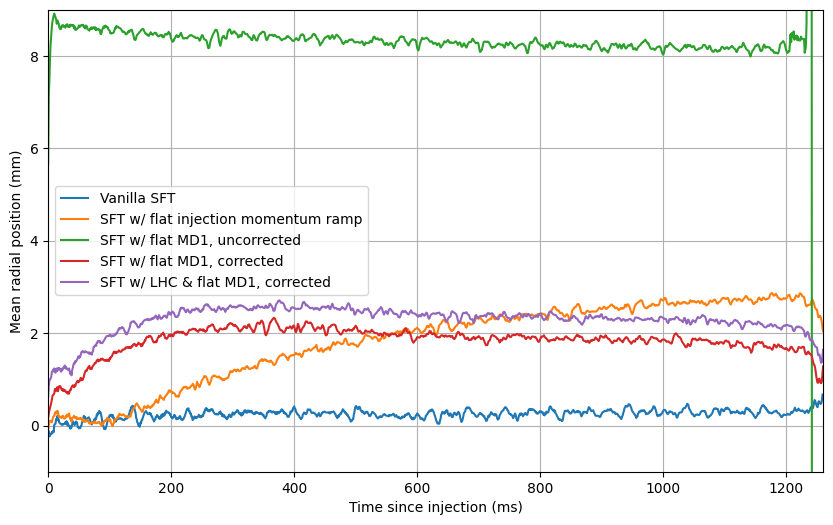
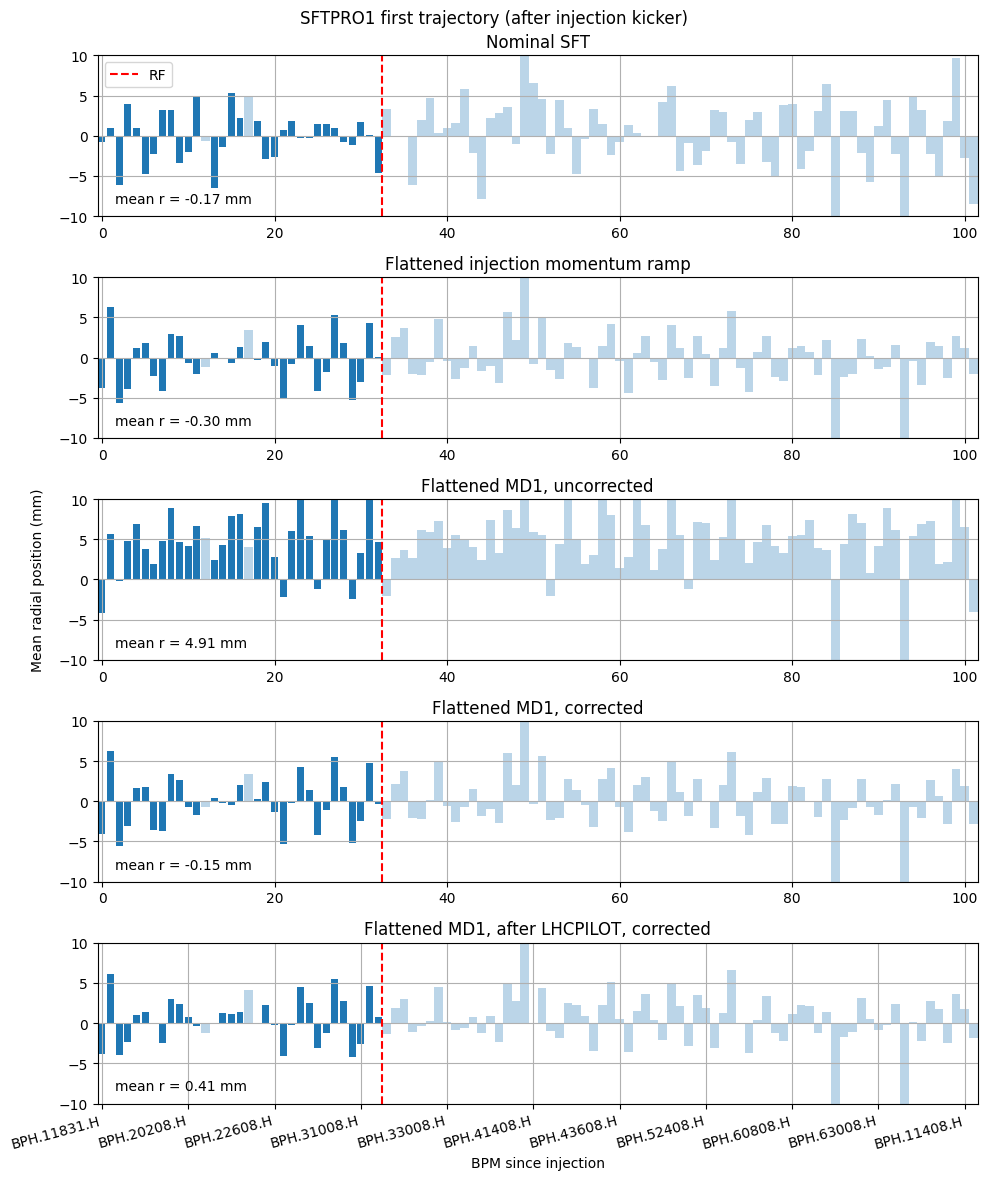
We start with core-only single injection at 5e11 intensity, and observe nominal first turn radial offset, and orbit drifting 0→0.3mm over the 1260 ms injection. We then flatten the momentum ramp on the injection plateau, and observe the same first turn offset (zero basically), and but the orbit drifts 0→2.0mm over the injection plateau (~0.5 G dipole offset), consistent with previous measurements. Next step we flatten the MD1 (actually here MD3) dipole function, and lost all the beam at the end of injection, while the first turn offsets 4.3-4.6mm (ca 1.1 - 1.2 G dipole field error), with the orbit more or less stable over the full 1260 ms, albeit kicked to 8mm offset by the RF.
Applying the eddy current correction we reduce the first turn offset to 2.0 mm, and then add a 0.6 G positive offset to the field, and reach zero-offset at first turn, but a 2.5mm orbit drift. Regardless with this configuration the beam passes injection and goes all the way to extraction. In the end we revert back to the trim from last week, which an eddy current model with different parameters.
Supercycle changing
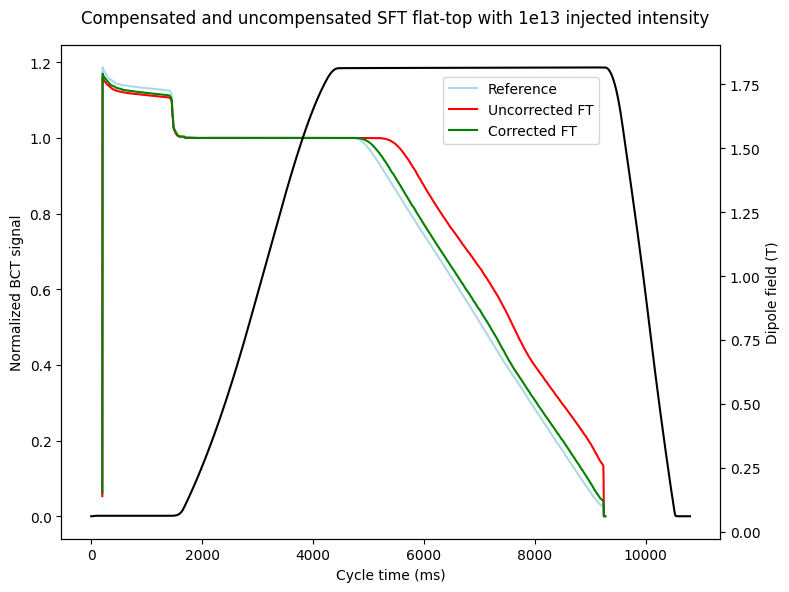
We change supercycle to SFT+LHCPILOT, and see the first turn change by +0.4mm more or less (about 0.15 G dipole field), with the same shift in orbit up to 2.4mm. In theory it’s possible that this is caused by the preceding cycle in the PS… We see a significant change in the spill, and a measured field offset at flat top around 3.5 G. Injection field is the same as before, as measured by the B-Train (0.15 G is beyond the measurement accuracy of the B-Train). We apply a single-shot correction to the flat top, and find that it fixes the spill shape. However we see large fluctuations in the spill, probably caused by the low intensity beam, so we increase intensity to one full MTE (~1e13).
For the field predictions we see some “kinks” in the prediction of the flat-top field, which causes poor predictions every now and then (this is now identified to be the calibration function being incorrectly rounded when saved, and therefore interpolates incorrectly). We also use the interpolated field predictions for more stable delta B.
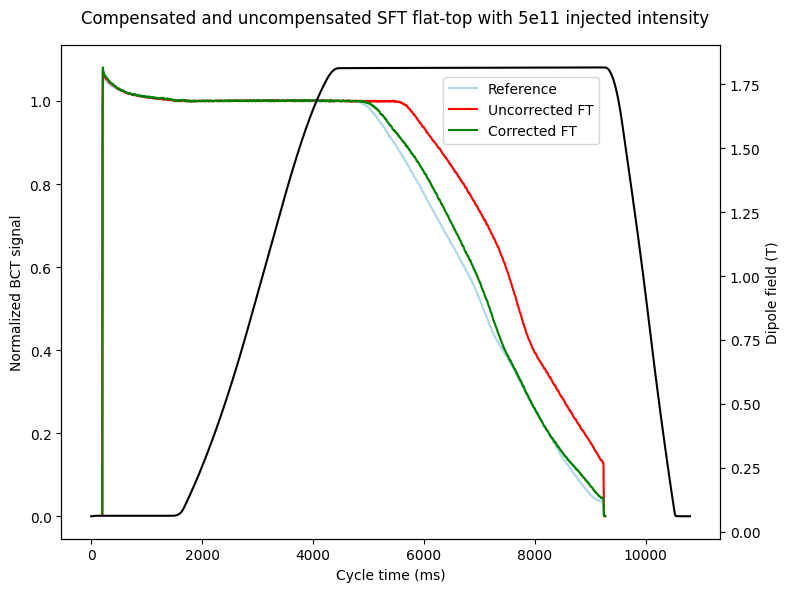
With the full MTE injection, we lose the beam immediately after injection as in previous MDs, so we decrease the horizontal chromaticity by hand, and then the beam passes injection. The predictions are not entirely stable, so we are not able to run trims non-stop. Overall the spill shape is on point when compensated.
The switch at 18:00:18 from 3x SFTPRO to 1x SFTPRO + LHCPILOT showed that without correction the spill would be bad (first screenshot shows first instance after SC switch) but is fixed in the next iteration thanks to Anton’s hysteresis correction.
Key takeaways
We can manually shift the injection dipole field by +5e-5 T to account for the missing MD1, and the transmission stays the same as with an MD1. The extraction field changes by up to 1 G, but this can be corrected for with hysteresis compensation. In an LHC supercycle, the injection stays similar enough to be acceptable, and the hysteresis compensation at flat top can take care of the rest.
⇒ MD1 does not do anything on flat bottom besides inducing eddy currents!
On the injection trajectories we see the following
The compensation is clearly not perfect - there are some kinks in the extraction seen on the BCT, which do not seem to be strictly related to the compensation, since it is present before compensation is enabled.
 When we increase the intensity, we see a much improved reference spill, and a consequent screwed up spill after transition to SFT + LHCPILOT (still flat MD1)
Measured field

Action
- Investigate cause of “kink” in predictions
- Was caused by incorrect rounding of the calibration function (v8) when it was exported, causing incorrect computation of the residual field.