Measurement consistency
The B-Train seems to yield inconsistent measurements +/- 0.2 G at flat bottom on SFT.
Experiment
Use a dataset: BC2024/SPS-BTRAIN-20240328-130003---20240328-145958-1kHz.parquet
The dataset is SFTPRO1_A → MD1 → LHC25ns → MD1 → SFTPRO2_B → MD1
Plot all SFTPRO1_A or _B at flat bottom, and overlay with standard deviation for each timestep, and do the same for current measurements.
Results
As show in the btrain_uncertainty.ipynb notebook:
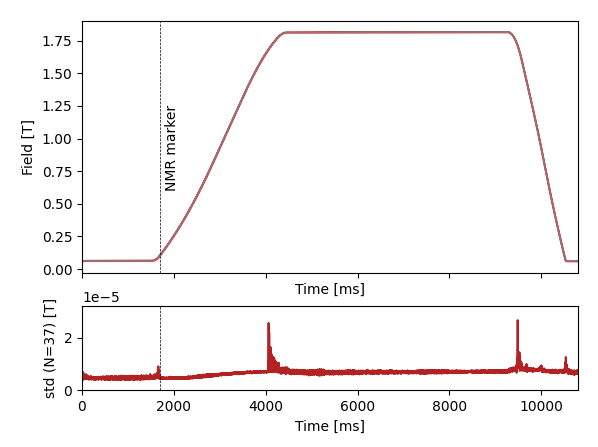
Consequently at flat bottom the uncertainty can be observed
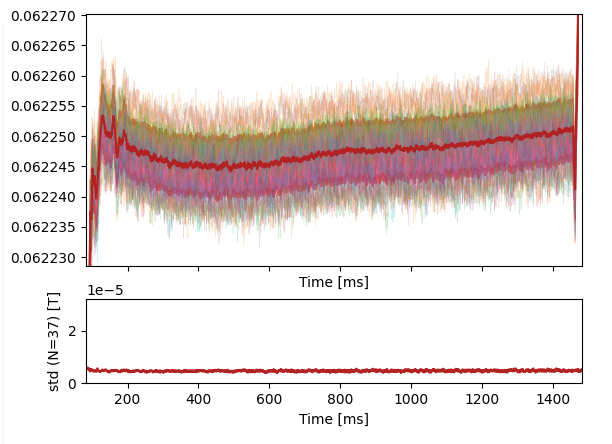
Where the shaded area is one standard deviation from the mean. The , i.e. where 95% of values fall in, at flat bottom, is .
Add results of study here, including hard data, to inform future decisions.
Programmed vs measured current
This is actually an experiment for FGC, but since we use the input current anyway…
The data is available in cernbox/hysteresis/dipole/notebooks/btrain_studies/imeas_vs_iref.ipynb.
We take data from
dataset = BTrainDataset.maybe_from_nxcals(
    start="2024-11-19-17:04:07",
    end="2024-11-19-17:15:38",
)
Which includes cycles MD1, MD5 and SFTION1 from Parallel MD 2024-11-19where we discovered the phenomenon of MD5 having a different field if the preceeding MD1 was zero current or normal (nominal).
This prompted a discussion during 2024-11-20 - WP4 Update meeting to investigate the difference between measured and programmed current.
Both measured and programmed current can be retrieved from NXCALS.
Residuals
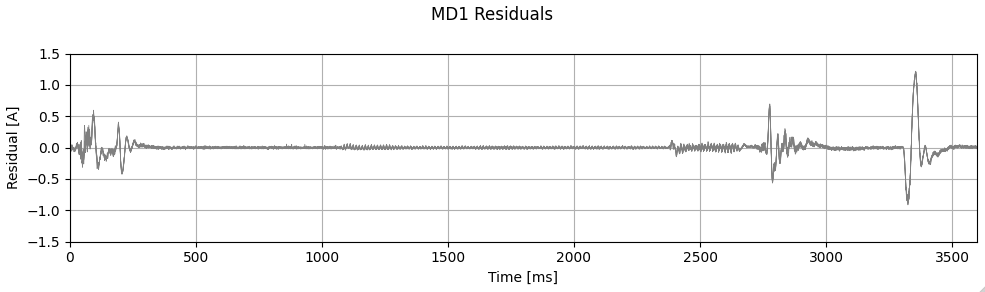
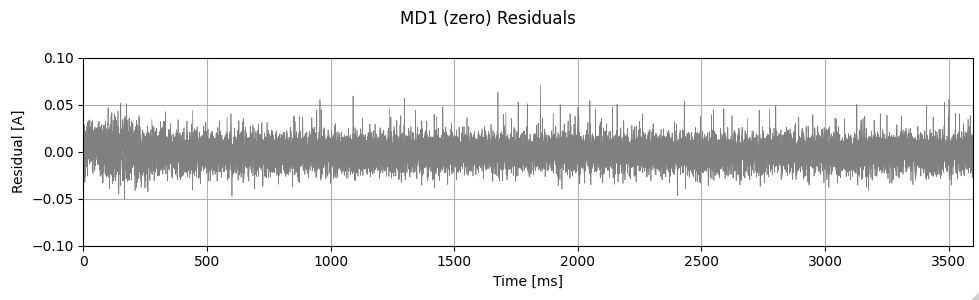
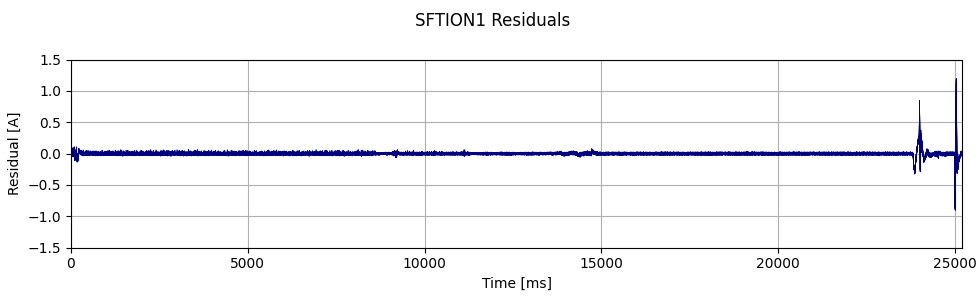
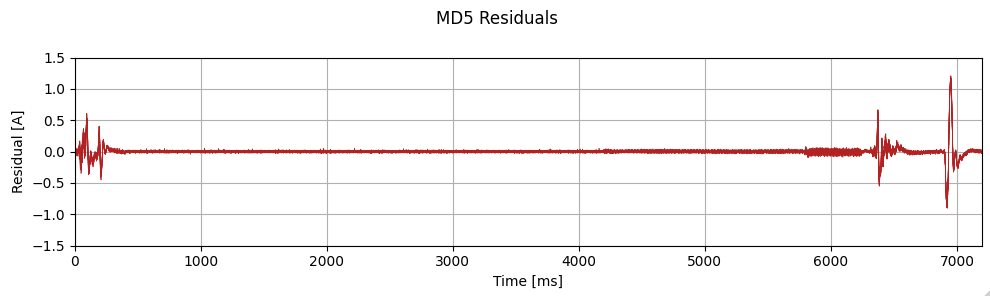
Residuals would suggest that the only remaining components are noise.
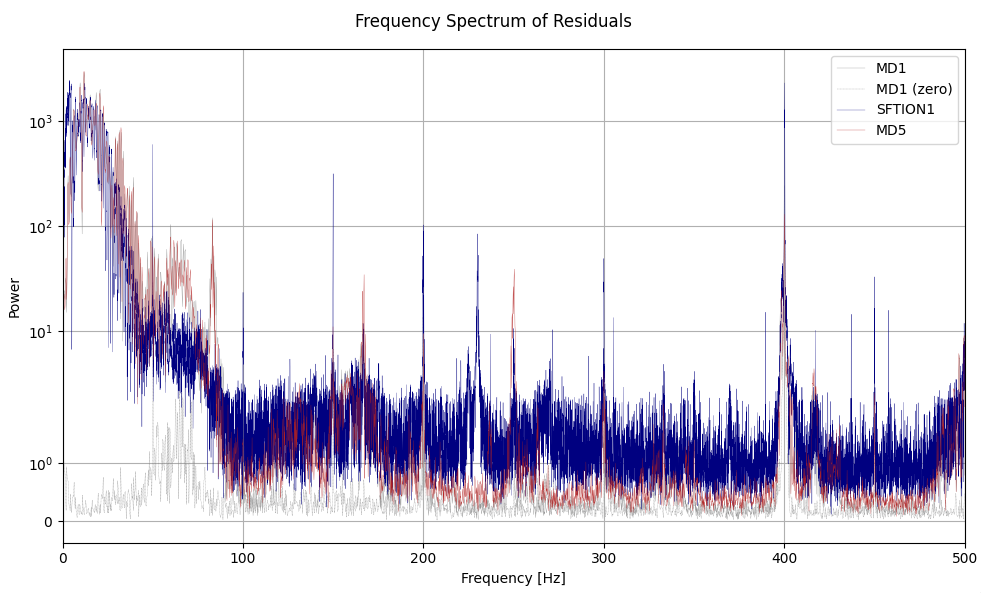
From the frequency spectrum we see that they are largey similar, and the lack of lower frequency components from the MD1 (zero) is likely due to the lack of ramping for that signal.
Statistical analysis of residual
MD1: mean=1.755e-05, std=0.119
MD1 (zero): mean=2.045e-04, std=0.012
SFTION1: mean=-1.523e-04, std=0.045
MD5: mean=-1.238e-05, std=0.083
The low mean of the current measurements (close to zero) suggest additive noise. The standard deviation of the residual is within the expectation.