Due to the power hungry nature of the SPS main magnets, the power converters (FGCs), employ two different so called economy modes that do not fully ramp the magnets, or does not ramp them at all. The economy modes are Dynamic Economy and Full Economy.
Dynamic Economy
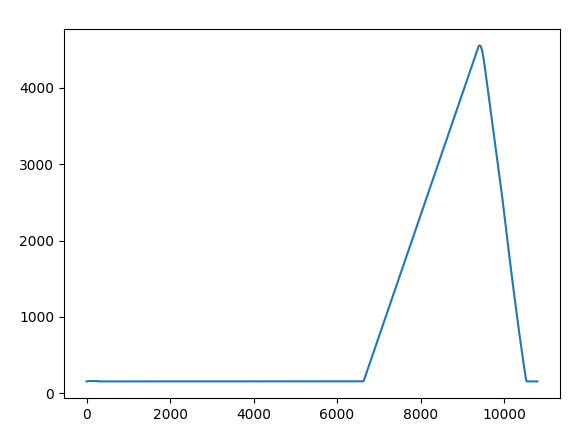 Dynamic economy for SPS MBIs x axis is CTime and y axis is Amperes.
Dynamic economy mode is triggered around injection in the SPS, if dynamic economy is enabled in LSA, and no injected beam is detected.
The corresponding (asynchronous) timing event for SPS is XTIM.SX.APECO-CT/Acquisition, which announces the #acqC when dynamic economy is triggered.
When dynamic economy is triggered, the FGC waits for a cooldown period, and then ramps the power converter down from the injection plateau to idle current. The idle current (also known as initial ref. current), is dependent on the machine. For the SPS Main Dipoles the idle current is .
The computation of the played current is done in real time in the FGC regulation, and there is no reference dynamic economy function stored in settings management, and the shape of the played reference current is set solely by the Dynamic economy parameters.
At the end of a dynamic economy cycle, the generated waveform “connects” to the reference current. In the case of the SFTPRO1, where the dynamic economy normally ends at 9500 ms (out of 10800 ms), the dynamic economy cycle “ramps up” according to hardware parameters, and curves into the ramping down function that it has to connect to.
Dynamic economy parameters
Configurable parameters
The sole configurable parameters available to the operators are
FGC_63/REF.ECONOMY.DYN_END_TIME#value- The time in seconds where the dynamic economy cycle should connect to the reference current. In other words, when dynamic economy ends.
Where FGC_63 should be replaced with the relevant device name (MBI/QD/QF)
Hardware parameters
The rate of change (ramp rate) of the current and hence the shape of the resulting generated dynamic economy reference current is determined by the hardware limitations set in the FGC, which can be retrieved from the hardware using a GET, and then used to generate the reference current.
FGC_63/LIMITS.V.POS#value[0]Maximum voltage (V)FGC_63/REF.DEFAULTS.I#acceleration[0]Maximum accelerationFGC_63/LOAD_HENRYS#value[0]Maximum inductance (H)FGC_63/LOAD.OHMS.SER#value[0]Resistance (O)
Some parameters I don’t remember and just wing it:
duration_parabolaDuration of the parabola that connects the ramp up to the ramp down (milliseconds)regulation_timeRegulation period of the power converter (in milliseconds)start_delayHow long after when dynamic economy is triggered until the power converter ramps down to idle current (milliseconds)initial_refIdle current, normally found in LSA (first and last point of anyIREFfunction) (A)
Dynamic economy in the real FGCs
The following are the known parameters for the SPS MBIs and SPS Main Quadrupoles:
MBI
reg_time_ms: 2.0  # ms
acceleration: 40000.0
duration_parabola_ms: 120.0
start_delay_ms: 50.0
load_ohms_ser: 50.0  # ohms
load_henrys: 6.7  # H
limit_v_pos: 26000.0
initial_ref: 155.7363  # A
QF
reg_time_ms: 4.0  # ms
acceleration: 15000.0   # QF/REF.DEFAULTS.I#ACCELERATION
duration_parabola_ms: 150.0
start_delay_ms: 60.0
load_ohms_ser: 1.58515  # ohms
load_henrys: 1.88  # H, QF/LOAD_HENRYS
limit_v_pos: 3900.0  # QF/LIMIT.OP.V.POS
initial_ref: 55.527  # A, QF/REF.DEFAULTS.I#MIN_RMS
dyneco_start_ct: 200
QD
The LOAD.OHMS.SER parameters is 1.6 Ohm in FGC, but found to be 1.60015 by matching computed IREF to measured current
reg_time_ms: 4.0
acceleration: 15000.0
duration_parabola_ms: 150.0
start_delay_ms: 60.0
load_ohms_ser: 1.60015
load_henrys: 1.99
limit_v_pos: 3900.0
initial_ref: 55.527
dyneco_start_ct: 200
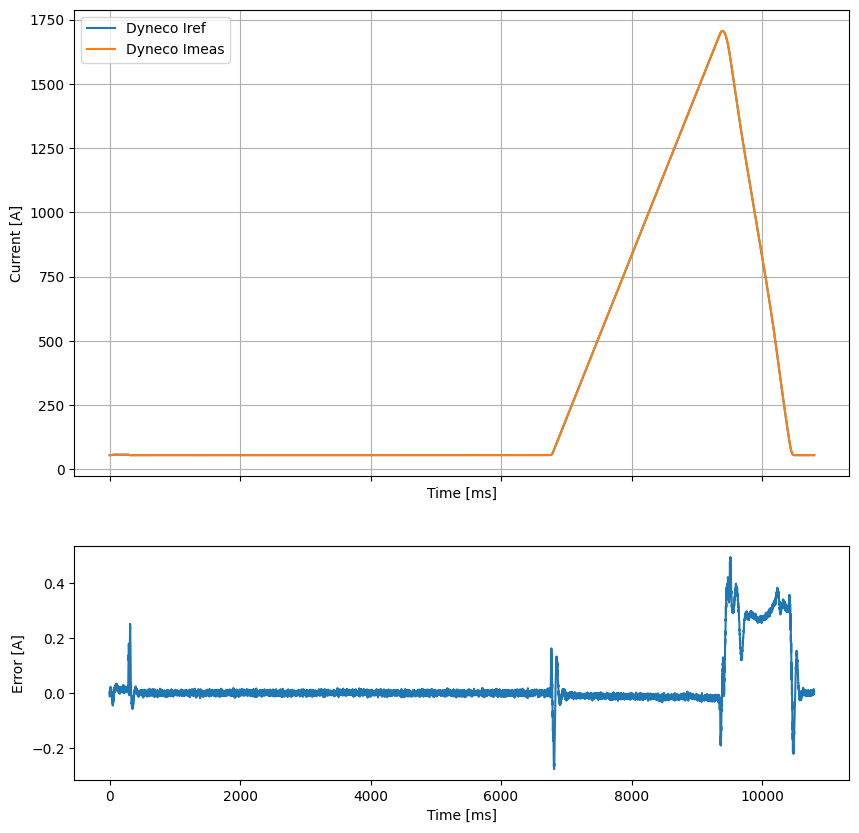 We see a good overall match between measured and reference current, minus some power converter ripples, and a slight mismatch during ramp down (0.4 A), which is not significant since there is no beam present anyways.
Dynamic economy implementation
The dynamic economy follows
The following file from the FGC repository shows how dynamic economy is implemented. https://gitlab.cern.ch/ccs/fgc/-/blob/master/sw/lib/cclibs/libref/src/refEvent.c?ref_type=heads#L163
Parameters
https://gitlab.cern.ch/ccs/fgc/-/blob/master/sw/lib/cclibs/libfg/doc/resources/PLEP.pdf
| Top of initial parabola | |
| End of initial parabola | |
| End of linear | |
| End of exponential | |
| Time of top of parabola | |
| Time of end of parabola | |
| Time of end of linear | |
| Time of end of exp | |
| Time of end of PLEP | |
| Linear rate of change |
Condition equations
P - P
We are at. P-P if
With
and and .
P - L - P
For the parabolic part:
Full Economy
FULLECO is a machine mode (MMODE), which sets the current of the main magnets on idle value (155 A for SPS Main Dipoles). The mode is signalled using the XTIM.SX.FCY-MMODE-CT/Acquisition timing signal, which fires 1150 ms before cycle start. This is due to the GMT backend of the timing system being unable to accurately determine the cycle more than 1 cycle ahead in time, in case the currently played cycle is 1 BP.